

Creating a well-thought-out strategy is essential, but it is of little value without proper execution. Strategy execution is the bridge between ambitious plans and tangible results. Despite having robust strategies, many organisations fail to implement them effectively (90% of strategic plans fail to succeed), leading to wasted resources, lost opportunities, and strategic stagnation.
This comprehensive guide explores what strategy execution truly involves, why it often fails, proven frameworks that support execution, best practices for success, and how modern tools like PlanStrategy can empower your business to bring strategy to life.
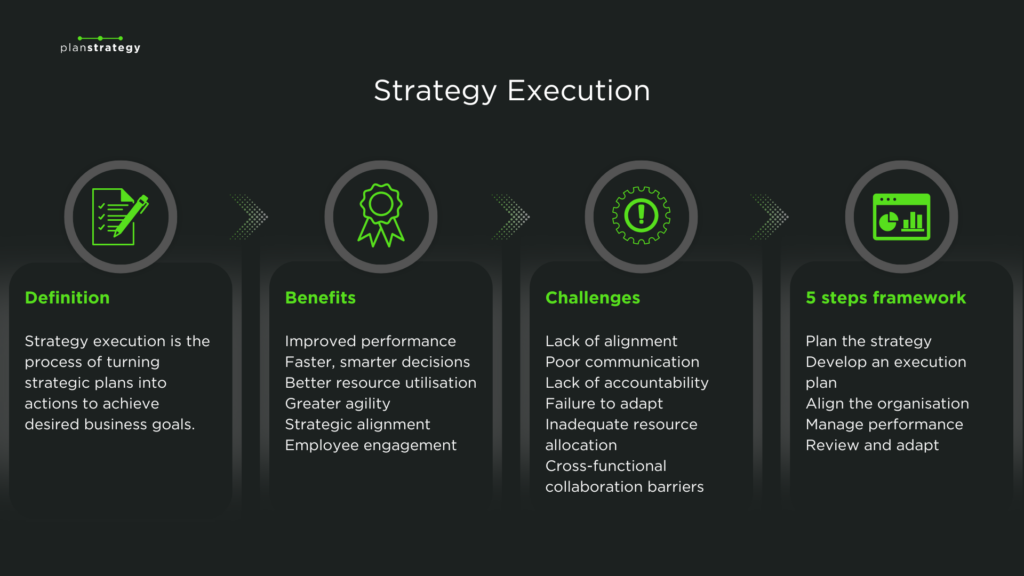
What is strategy execution
Strategy execution refers to the process of turning strategic plans into actions to achieve desired business goals. It involves aligning teams, allocating resources, managing performance, and adapting to changing conditions.
At its core, strategy execution ensures that everyone and everything in the organisation works together to translate strategic intent into concrete results. It’s not just a phase after planning; it’s a continuous, iterative cycle that blends strategy with operations, decision-making, and performance.
Think of it as a dynamic system, not a one-time event. True execution means your strategic objectives are embedded in daily actions, resource allocation, team responsibilities, and feedback loops.

Why organisations struggle with execution
- Lack of alignment: when teams and departments don’t see how their work connects to strategic goals, execution suffers. Misalignment creates confusion, disengagement, and inconsistent performance.
- Cross-functional collaboration barriers: execution requires seamless collaboration across departments, but silos, conflicting incentives, and unclear responsibilities often get in the way. Without strong coordination, execution efforts become fragmented and inefficient.
- Poor communication: vision and strategy must be communicated clearly and frequently. When messages are inconsistent or don’t reach all levels of the organisation, teams lack direction and clarity.
- Inadequate resource allocation: strategies need the right people, tools, and budgets to succeed. When key initiatives are under-resourced or unsupported, execution stalls.
- Lack of accountability: without clear ownership and follow-through mechanisms, tasks get delayed, and progress slows. Accountability is essential to maintaining momentum and driving results.
- Failure to monitor and adapt: strategy execution is not a “set it and forget it” process. Success requires real-time visibility into performance. However, defining the right metrics, gathering accurate data, and acting on insights can be overwhelming for many organisations.
The benefits of strategy execution
When executed effectively, strategy execution transforms your organisation from a collection of disconnected efforts into a focused, high-performing engine for growth. It ensures that every action, investment, and initiative contributes directly to your strategic vision.

Improved organisational performance
When strategy guides day-to-day operations, organisations perform better. Teams align their actions with clear strategic priorities, driving measurable results across functions. Strategic focus reduces waste, eliminates duplication, and boosts productivity.
Faster, smarter decision-making
A strong execution framework enables decision-makers to act quickly and confidently. With access to real-time data, clearly defined goals, and visibility into progress, leaders can adjust course proactively, responding to market shifts or internal challenges without losing momentum.
Better resource utilisation
Strategy execution ensures that time, budget, and talent are directed toward the most impactful initiatives. It reduces misallocated resources and ensures that teams focus on what truly moves the business forward.
Greater agility and adaptability
Strategy execution processes allow organisations to respond quickly to change, whether it’s customer behaviour, competitive threats, or market disruptions, while staying aligned with core objectives.
Stronger strategic alignment
Execution connects high-level strategy with on-the-ground actions. Everyone in the organisation, from executives to frontline teams, understands how their work contributes to the broader vision. This clarity promotes consistency and unity of purpose.
Higher employee engagement and accountability
When employees can see the direct link between their efforts and the organisation’s success, engagement increases. Strategy execution frameworks empower individuals with clear roles, measurable objectives, and ownership over outcomes, fostering both motivation and accountability.
5-step strategy execution framework

A well-structured framework is essential for bridging the gap between strategy and execution. These five steps ensure that strategic plans are not only well crafted but also successfully implemented across the organisation:
1. Plan the strategy
Every effective execution journey begins with a well-defined strategy. Developing a strategy involves analysing the internal and external environment, setting a clear vision, and identifying long-term goals. A sound strategy outlines the organisation’s direction and priorities, forming the foundation upon which execution is built.
A good strategic planning process should:
- Set a compelling long-term vision at the corporate level that guides the organisation’s direction and purpose.
- Ensure alignment across business units so that their specific strategies directly support the overall corporate objectives. Each unit should translate the high-level vision into more detailed, actionable priorities relevant to their domain.
- Translate strategy into functional areas, like marketing, sales, operations, and finance, ensuring that departmental plans actively contribute to broader business goals.
- Embed strategic intent into daily operations, turning the big picture into tangible actions. When operational strategies are tightly linked to corporate goals, frontline teams are better equipped to make decisions that reinforce strategic success.
Planning the strategy is about creating clarity. Everyone in the organisation, from executives to individual contributors, should understand how their actions connect to the bigger picture. This alignment not only enhances focus and collaboration but also empowers smarter, more strategic decision-making at every level.
2. Develop an execution plan
Once the strategy is defined, it must be translated into an actionable roadmap. This stage involves identifying key initiatives, allocating resources, assigning responsibilities, and setting timelines. Without a concrete execution plan, strategy remains theoretical and disconnected from daily operations.
A critical but often overlooked component of this phase is timing. Strategy doesn’t live in a vacuum; it operates in a fast-moving, unpredictable environment. Leaders often focus on the “what” and “why” of strategy but neglect the “when.” Building effective timelines is essential to move from planning to execution without losing momentum.
To create a realistic and agile execution timeline, organisations should ask:
- What do we need to act on immediately, and why?
- What can and should be delayed?
- How long should each strategic initiative take, and are those expectations feasible?
3. Align the organisation
Strategic alignment is about ensuring everyone is working towards the same objectives. This requires clear communication, cascading goals across all departments, and breaking down silos. When teams understand how their work contributes to the bigger picture, execution becomes more coordinated and effective.
Alignment with company goals gives structure to execution. By linking each initiative to overarching business priorities, you create strategic clarity, enabling teams to focus on what truly drives progress and avoid distractions that dilute impact.
The process of alignment also uncovers valuable insights that can help refine your plan before execution begins:
- Is the strategy realistic, considering your current resource and capacity constraints?
- Do you have the right people and skills in place to deliver every part of the plan?
- How well do individuals and teams understand the company’s high-level objectives?
4. Manage performance
Execution success depends on tracking progress and holding individuals accountable. At this stage, organisations must establish relevant KPIs, monitor performance in real-time, and review outcomes regularly. Performance dashboards and regular check-ins help identify what’s working, what’s not, and where corrective action is needed.
To drive real impact, performance management must be embedded into the strategy execution process from the beginning. This means moving beyond static dashboards or annual reviews and adopting a dynamic, continuous feedback loop.
Key principles for effective strategic performance management include:
- Direct alignment between individual goals and strategic priorities: every team member should know how their role contributes to the broader vision. When KPIs and personal objectives are tied to the strategy, people become more focused and accountable.
- Transparent, fair, and engaging systems: traditional performance reviews often feel bureaucratic and unhelpful. A modern approach should be simple to use, easy to understand, and even motivating, creating a culture of ownership rather than compliance.
- Recognition and real-time course correction: performance management isn’t just about evaluating, it’s about enabling. Regular check-ins allow leaders to spot misalignments early, adjust plans, and recognise achievements tied to strategic outcomes.
Performance management should serve as the engine room of strategy execution, providing the insights and feedback needed to keep the organisation aligned, motivated, and continuously moving forward.
5. Review and adapt continuously
Strategy execution is not a one-off event; it’s an ongoing process. The final step involves reassessing the strategy and its execution based on results, feedback, and changes in the business environment. Organisations must remain flexible, making necessary adjustments to stay aligned with their strategic goals.
The final stage in effective execution is about turning good strategies into great ones through ongoing optimisation and strategic learning.
This phase goes beyond simple reporting. It involves critical reflection across multiple levels of the organisation to understand what’s working, what isn’t, and where resources or priorities should shift. Done well, it can create a cultural flywheel—where constant improvement becomes embedded in how the business operates.
To do this effectively:
- Leverage continuous feedback loops: use data from execution (including KPIs, team insights, and project outcomes) to inform strategic updates. This ensures you’re not just repeating the same cycle but refining it each time.
Review the alignment between strategy, plans, and outcomes: regularly check for misalignments between what was planned, what was done, and what was achieved. Are teams working on the right things? Are initiatives delivering the expected impact? - Spot and resolve inefficiencies: identify bottlenecks, overlapping efforts, or low-impact initiatives. Redirecting or stopping these can unlock capacity for more valuable activities.
- Maintain strategic agility: the ability to adapt is a competitive advantage. Real-time insights and structured reviews help leaders revise strategies confidently without waiting for the next annual cycle.
Ultimately, this optimisation loop feeds back into the start of the strategy process, helping leaders make sharper decisions, allocate resources more wisely, and close the gap between vision and execution over time.
Best practices for effective strategy execution
Turning strategic plans into tangible results requires more than good intentions—it calls for discipline, clarity, and the right execution habits. Here are some proven practices that can significantly increase your chances of success:
Prioritise ruthlessly
Resist the urge to do everything at once. By focusing on a handful of high-impact strategic priorities, leaders can avoid overextending teams and resources. This sharpened focus leads to better engagement, clearer execution paths, and measurable outcomes. Less is often more when it comes to successful strategy execution.
Balance day-to-day operations with long-term strategy
One of the most common execution pitfalls is losing sight of the bigger picture amidst daily operational pressures. Strategic priorities can easily take a back seat to urgent issues. The solution? Build regular strategy reviews, feedback loops, and goal-tracking into operational rhythms. Make long-term execution an ongoing conversation, not a once-a-year exercise.
Translate strategic goals into concrete initiatives
High-level visions must be broken down into actionable steps. This means converting broad objectives into clear programmes, projects, tasks, and milestones. Each initiative should have a clear purpose, timeline, and success criteria. This clarity turns vision into motion.
Establish clear accountability
Execution requires ownership. Assign specific responsibilities to individuals or teams for each strategic initiative. When everyone knows who is responsible for what and how success will be measured, accountability becomes a driver of progress, not a source of confusion.
Allocate resources with intention
No strategy can succeed without the right support. Ensure that budgets, time, technology, and talent are aligned with your strategic priorities. Leaders should regularly assess whether resources are being channelled towards what truly matters, and make adjustments when they’re not.
Embrace agility through frequent review and adaptation
Strategy is not static. Market conditions, customer needs, and internal capabilities all evolve. That’s why regular check-ins, performance reviews, and the willingness to pivot are critical. Stay open to change, refine what’s not working, and double down on what is. Adaptation is not a failure—it’s a sign of strategic maturity.
Create a dedicated strategy execution team
Don’t leave execution solely in the hands of senior leadership. Build a cross-functional strategy execution team made up of decision-makers, implementers, and on-the-ground contributors. This group should be empowered to monitor progress, surface risks, gather insights, and refine plans. Including those directly involved in implementation ensures that the strategy is realistic, grounded, and more likely to succeed.
Leverage strategy execution tools
Relying on spreadsheets, emails, or disconnected tools to track execution is inefficient and error-prone. These methods make it difficult to keep data current, maintain visibility, or respond quickly to red flags. Instead, invest in purpose-built strategy execution software. These platforms offer real-time dashboards, collaborative planning, performance tracking, and integration with your existing systems, making it far easier to stay on track, measure impact, and scale what works.
Effective strategy execution is not about ticking boxes, it’s about creating the conditions for sustained progress and organisational alignment. When strategy becomes part of your operating rhythm, success becomes repeatable.
Master strategy execution with PlanStrategy
PlanStrategy is a strategic decision engine combined with an execution platform that empowers organisations to turn strategy into action, and action into measurable results. It centralises your entire strategic process, aligns teams around shared goals, and tracks performance in real-time to keep you focused, fast, and flexible.
Key benefits of PlanStrategy
Faster, smarter decision-making
Leverage AI-driven insights and market intelligence to make data-informed strategic choices, reduce guesswork, and identify high-impact opportunities early.
Strategic clarity & focus
Translate your vision into actionable plans. PlanStrategy helps you prioritise what matters most, break down objectives into initiatives, and assign clear ownership, so everyone knows what to do and why it matters.
Alignment across the organisation
Keep leadership, teams, and departments on the same page. With built-in communication tools and visual roadmaps, PlanStrategy ensures that strategy is understood, embraced, and executed at every level of the company.
Real-time monitoring & adaptation
Track execution in real time, monitor KPIs, and get automatic alerts when progress stalls. PlanStrategy empowers you to adapt plans quickly in response to internal or external changes, keeping your company agile and resilient.
Better resource allocation
Ensure your people, time, and budget are invested in the most strategic initiatives. PlanStrategy helps you evaluate impact, prioritise projects, and eliminate wasteful efforts.
End-to-end strategy execution
From vision to results, PlanStrategy supports the full lifecycle of strategy: definition, execution, performance management, and optimisation. No more siloed tools or disjointed reports—just one intelligent system built for strategic success.
More alignment. More agility. More impact.
PlanStrategy helps businesses drive results, scale with confidence, and turn strategy into a continuous competitive advantage.
UNLOCK YOUR FREE PLAN
We’re opening Early Access soon. Limited spots available.
Don’t miss it — leave your email to get priority access.


