

The single most effective lever for both winning business and commanding premium fees lies in your ability to quantify, communicate, and connect the measurable value of predictive analytics to the economic goals of C-suite decision makers. This report presents a strategic framework, tailored for consulting leaders, enterprise clients, and the PlanStrategy audience, for mastering value-based pricing conversations, establishing trust, and securing profitable, lasting engagements through predictive analytics.
Firms that anchor pricing and client discussions in a compelling, rigorous quantification of ROI achieve 2–4× higher project returns than those using traditional consulting models. The strategic advantage lies not in algorithmic complexity, but in a disciplined advisory approach: surfacing true client value drivers, collecting baseline data collaboratively, deploying best-practice quantification techniques, and positioning results in C-level, outcome-oriented language. This approach turns pricing into a boardroom lever, not a procurement negotiation and elevates the consultant from vendor to transformative partner.
A Strategic Framework for Quantifying Predictive Analytics ROI
A successful value-driven approach demands an end-to-end workflow that integrates discovery, measurement, and executive alignment.
Value Driver Discovery: The Strategic Starting Point
Every C-suite is bombarded with analytics pitches. What earns trust is the ability to translate generic promises into client-specific value drivers. This involves a deep-dive into the organization’s growth objectives, margin levers, risk profile, and strategic pain points.
Top drivers include:
- Revenue Growth: Advanced segmentation, pricing optimization, targeted upsell/cross-sell models
- Cost Reduction: Forecast-driven procurement, automated operations, churn reduction
- Risk Mitigation: Fraud/red flag prediction, supply chain disruptions, asset failure avoidance
- Efficiency Gains: Streamlined resource allocation, process automation, reduced cycle times
Strategic advisors facilitate these conversations by grounding value hypotheses in customers’ board-level priorities and translating them into quantifiable business metrics.
Baseline Data Collection: Gathering Evidence, Not Hype
Value quantification requires real data—from financial baselines to operational pain points. Collaborating with client teams to obtain credible, historical numbers (e.g., churn rates, maintenance spend, sales lift, or downtime costs) builds buy-in and creates the foundation for defensible ROI estimates. Where internal data is sparse, use external benchmarks, conservative assumptions, or propose an initial “diagnostic phase” to reduce risk and scope accurately.
Quantifying Impact: Proven Methods
The credibility of your proposal depends on using robust and transparent ROI quantification methods, tailored to strategy-minded executives.
Common Methods for Quantifying Predictive Analytics Value
1. Direct ROI Calculation
The classic: (Value gain – Cost)/Cost(Value gain – Cost)/Cost. Ideal for projects with clear cost savings or revenue uplift.
2. Payback Period
Time needed for value generated to recoup the investment, critical for CFOs emphasizing cash flow.
3. Net Present Value (NPV)
Present value of future cash flows from analytics-informed business changes, discounted appropriately—vital for long-term initiatives.
4. Risk Reduction Value
Quantifies the avoided cost of negative outcomes (fraud, failures) times reduction in event likelihood (e.g., 30% fewer losses).
The most strategic advisory teams present a range, stress-test assumptions, and are clear about probabilities, not just “average expected” results.
DISCOVER PLANSTRATEGY
Ready to transform your business strategy with agentic AI? Discover how PlanStrategy can empower your enterprise with real-time insights and intelligent decision-making.
Strategic Pricing Model Selection
Moving beyond hourly or feature-based pricing unleashes the power of quantified value. Strategic models include:
- Value-Based Pricing: Fee set as a % of projected ROI—a strong fit for high-confidence predictions but requires shared risk appetite.
- Fixed-Price by Outcome: Pricing tied to the achievement of measurable KPIs (reduce churn by X%, achieve Y in savings).
- Tiered Packages: Linking price to levels of service, model complexity, or guaranteed outcomes.
- Retainer + Bonus: Combining base fees with performance-linked bonuses aligns incentives for both sides.
Always anchor your proposal in the documented, quantified value—making your price a share of client upside, not just an isolated cost.
Executive Communication: Boardroom-Proof Value Stories
Your most powerful asset is the ability to communicate value in a language and format familiar to C-level leaders.
- Lead with quantified impact, not technical jargon.
- Use concise, graphical summaries of potential ROI, NPV, or payback period.
- Clearly link analytics outcomes to enterprise business strategy (e.g., linking improved forecasting to sector leadership).
Interactive, visual proposal tools, and executive-focused pricing platforms enhance clarity and reinforce trust.
Negotiation and C-Suite Alignment
When price sensitivity and skepticism arise, elite consulting teams redirect discussions from “budget” to “net gain.” Strategic reference points include:
- “For a $X investment, projected ROI is Y%; payback period is Z months.”
- Comparative benchmarks with traditional consulting approaches—where predictive services deliver 200–400% ROI versus 60–120% for traditional consulting.
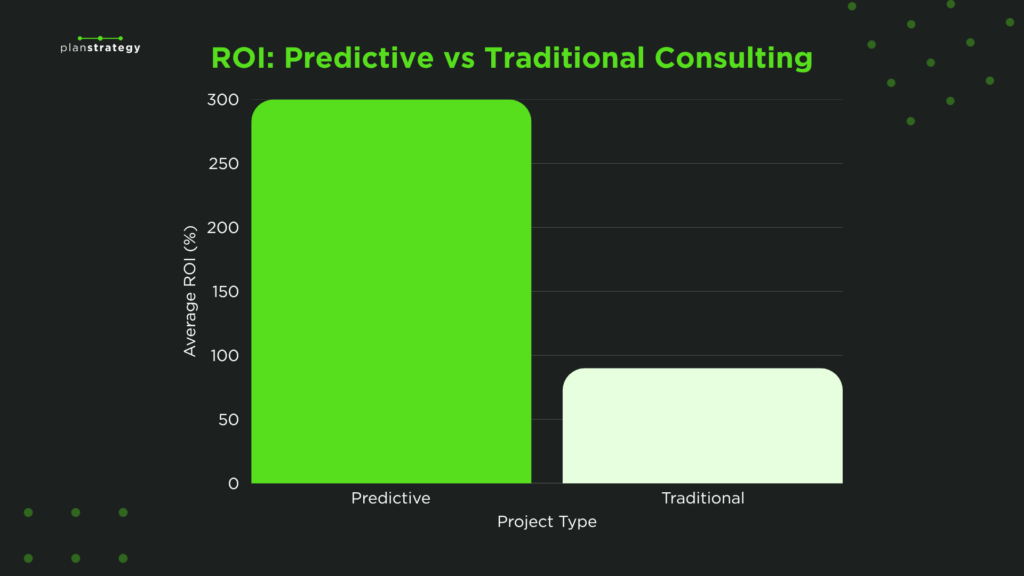
This frames the debate as: “How does this investment stack up against other board-level priorities?”
Feedback Loop: Continuous Value Realization
Post-sale, value realization should be tracked and re-communicated, closing the loop between predicted and actual impact. This reinforces credibility, uncovers new opportunities, and sets the foundation for long-term partnership.
Benchmarks: What Leading Firms Achieve
- 18% reduction in operational costs and 25% increase in revenue through predictive analytics strategies.
- 200–400% ROI typical for best-in-class, analytics-enabled projects, with payback periods of 6–18 months—far outpacing traditional consulting returns.
Early adopters of predictive pricing technologies see measurable improvements in top-line growth, customer retention, and resource allocation.
Key Takeaways for Consulting Leaders and Enterprise Clients
- Boardroom perspective matters: Quantification and storytelling rooted in enterprise strategy win buy-in where tech demos do not.
- Adopt a disciplined advisory workflow: Prioritize discovery, baseline alignment, conservative quantification, and transparent communication.
- Position your pricing as a strategic investment: Benchmark returns, defend fee as a fair share of delivered economic value.
- Use modern tools for engagement: Visual, scenario-rich tools and dashboards reinforce clarity and confidence.
- Commit to outcome tracking: Deliver regular impact reports; use value realization as a lever for expansion.
Conclusion
The strategic future of predictive analytics consulting belongs to those who master value quantification and communication—empowering clients to see not just predictive models, but transformational business results. For PlanStrategy, this means designing every engagement, proposal, and pricing discussion around the language, logic, and ROI-centric rigor demanded by the 2025 C-suite.
By focusing on the strategic outcomes, disciplined measurement, and boardroom-ready presentations, predictive analytics initiatives will not only justify their premium, but elevate the firm to the level of trusted strategic partner.

